
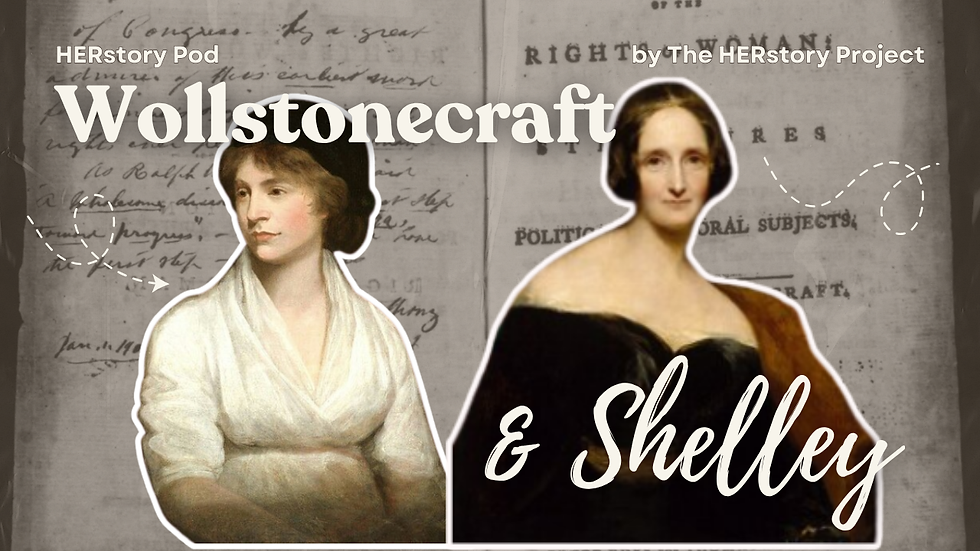
#11 Wollstonecraft and Shelley
Mary Wollstonecraft, Mary Shelley, Frankenstein, The Vindication of the rights of women
Wollstonecraft Early Life
Born in Spitalfield to moderately successful silkweavers on 27 April 1759
Spitalfields was a working class neighborhood home to leather tanneries, weavers, and silkmakers (the name spitalfields comes from the smell of urine which dominated the neighbourhood due to the tanneries)
Mother: Elizabeth Wollstonecraft who Mary never had a great relationship with
She never defended herself or spoke against her husbands abuse and Mary saw her as an absentee and uncaring Mother - she is not depicted kindly in Maria Mary’s semi-autobiographical novel
Father: Edward Wollstonecraft - it was his father who owned the silkweaving business but when he died and Edward inherited a share, the man had little interest in business so decided to become a gentleman farmer
Wollstonecraft from her own descriptions of her father in her diary and discussions with Goodwin which we have record of describes her Father quite poorly as a foolish man taken to bullying his wife and children after drinking
Wollstonecraft was known to try and protect her mother in particular from her father’s abuse
Siblings: Mary had multiple siblings - an older brother Edward, known as Ned, who her Mother adored, another three brothers, Henry, James and Charles, and two sisters, Everina and Eliza
Wollstonecraft had a deep love for her sisters in particular which she’d exhibit throughout her life, including helping Eliza flee from her husband while the woman was suffering from postpartum depression (most likely)
Her other notable friendship was with Fanny Blood who would become a lifelong friend
At a young age, Edward moved the family to Essex to start a farm which saw little success, they would continue to move a number of times including to Yorkshire, Wales, Epping, and London (where they eventually settled again permanently)
Mary throughout this time had a few defining friendships, perhaps most notably with Jane Arden which Mary described as a “romantic friendship” (some scholars have speculated there was a true romance between the two). They would often read together or attend Jane’s father’s lectures
Education: Only Ned received a formal extended education of a gentleman, the rest had a few years of schooling here and there. Mary herself only had a few years of formal schooling where she learned to read and write
Most of Mary’s many skills exhibited later in life were self taught not acquired through formal education systems, hence her own indignation at the system
Wollstonecraft and Early Poverty
By Mary’s late-teens the family was facing rising levels of poverty largely due to her fathers mismanagement; it was clear that Mary, as the eldest daughter, would either need to marry for money or seek employment. Mary chose to seek employment
She worked briefly in a number of positions as a ladies companion (which she rarely enjoyed), a governess, and a school teacher. She then briefly returned home to care for her dying mother before briefly moving in with Blood and her family
She would briefly run a school for girls with Fanny Blood and her sisters in London which would be a financial failure (and during which Blood would marry and then died during a pregnancy which devasted Wollstonecraft), but it was during this time she wrote her first treatise Thoughts on the Education of Daughters (1787)
The piece earned her an impressive 10 pounds and gave Mary the confidence as an author, though it was not enough to keep her from needing to seek further employment
The piece highlights the importance Mary placed on a women’s education and was a direct contestation of Enlightenment views being posited by male philosophers
See Rousseau’s Emile for reference (1762) - it was a piece Mary would have been familiar with
“This principle being established, it follows that woman was specifically made to please man…If woman is made to please and to be subjugated to man, she ought to make herself pleasing to him rather than to provoke him; her particular strength lies in her charms; by their means she should compel him to discover his own strength and put it to use. The surest art of arousing this strength is to render it necessary by resistance. Thus pride reinforces desire and each triumphs in the other's victory. From this originates attack and defense, the boldness of one sex and the timidity of the other and finally the modesty and shame with which nature has armed the weak for the conquest of the strong.”
Mary’s work by comparison: ““She who submits, without conviction, to a parent or husband, will as unreasonably tyrannise over her servants; for slavish fear and tyranny go together.”― Mary Wollstonecraft, Thoughts on the Education of Daughters
Mary Shelley Early Life
Birth: born 30 Aug 1797
Mother: Wollstonecraft died of puerperal fever just eleven days after giving birth
Father: the political radical and writer William Goodwin (I fucking hate this man)
Shelley’s birth, it’s fair to say, was traumatic and left Goodwin raising both Mary but also Fanny Imlay (at this point going under Fanny Goodwin as his adopted daughter - the only good thing he did, though was Fanny ever treated properly, probably not)
After Wollstonecraft’s death Goodwin remarried quite swiftly in 1801 to his neighbour Mary Jane “Clairmont”
Clairmont had two (likely illiegitimate) children of her own who joined the swiftly growing family - Charles Clairmont and Clara (Claire) Clairmont who spent the rest of their childhood with Mary
Mary Jane and William would have one more child together, William Jr.
Much of Mary’s early childhood was spent surrounded by Goodwin’s radical political friends as well as the early romantic poets with whom he was acquainted, giving her an early taste for literature
Mary would attend a number of schools for girls, including one for the daughters of dissenters, but much of her education likely happened at home - Goodwin was an exacting tutor and again, she spent her life surrounded by authors. She grew up encouraged to be intellectual, even studying latin, and would often attend public lectures and scientific displays with her father
Like her father, Mary was known, throughout her life, to spend each morning studying and writing
Observers, including the likes of Aaron Burr who had the privilege of listening to one of Mary’s early lectures (delivered by her brother), The influence of governments on the character of a people, were deeply impressed by the young Mary’s intellect and writing abilities
In 1811 William Godwin described his daughter as 'singularly bold, somewhat imperious, and active of mind. Her desire of knowledge is great and her perseverance in everything she undertakes, almost invincible.'
Mary and her stepmother never got along across her childhood, but it is unquestionable Mary Jane was a strong woman and semi-accomplished author in her own right
Mary Jane is the one who would manage the families publishing firm and later book shop which would see varying levels of success (and thus financial stability)
Wollstonecraft’s early literary career
Mary would only continue to work as a governess for a while longer before making the acquaintance of Joseph Johnson, a radical publisher. He agreed to publish Mary’s piece at his press and soon took her under his wing, having her write for his Analytical Review and even finding her a home and lending her money after she lost her latest governess job
She also worked as a translator for Johnson, likely where she sharpened her linguistic skills - she worked as many working literary women did, surviving via translations and popular stories published in anthologies
Important to note that Wollstonecraft wasn’t the only female writer of the time though she was one of few who wrote on political issues
It was during her time in Johnson’s employ she would have her first male romantic attachment with Henry Fuseli, a painter Mary seemed to be quite besotted with but who was married and would not leave his wife.
Indeed Mary at one point met with his wife and suggested they cohabitate which was not received well
In this age throughout the 80s Mary styled herself as a kind of bohemian writer wearing coarse clothing and loose hair
Mary and Shelley
Mary first met Shelley in 1812 at her father’s house where he was visiting with his wife Harriet, though Mary would shortly go to stay with her Father’s friends in Dundee Scotland to recover from an infection in her arm
In this interim, her Father developed a close friendship with Shelley which included his financial assistance, by the time Mary returned, she likely would have been acquainted with him through her correspondence with home. The pair would meet again in person upon Mary’s return to London
The pair began to meet regularly at Wollstonecraft’s gravesite in St. Pancras and soon fell in love
It was a match made in heaven - she was 17, beautiful and had literary parents’ who Shelley idiolized, and he, only 5 years her senior, was a published poet already financially supporting her family
Both Goodwin and Mary Jane worked to break off the match - Shelley was married at the time afterall - but with his own radical stances against marriage alongside Wollstonecrat’s it’s unsurprising Mary was unconvinced
In July of that year, Mary would run away with her stepsister Claire to meet Shelley and the three would run to the continent where the pairs life together truly began
The three would move around quite often, living a fairly bohemian lifestyle of writing, studying, reading, and traveling
While there, they also met Lord Byron who would later strike up an affair with Claire Clairmont
While on these travels Mary would start to write jointly with Shelley - this would eventually be published upon their return to England in piece that included pieces from their travel journal alongside letters and poems (including Mont Blanc) - History of a Six Weeks’ Tour of France, Switzerland, and Germany (1817)
In 1814 the threesome would return to England penniless and with Mary pregnant -
They were not well-received in England by family or friends and soon Shelley would loose the protection of his noble family, leaving them to face the full brunt of living an alternative lifestyle
It was only in 1815 when Shelley’s grandfather died and granted him an allowance in his will that financial hardships eased - after this income the couple would settled in Bishopsgate with their daughter
The pair would have another son here, name William, though tragically their daughter passed a few days later
Wollstonecraft the political commentator
During this time Mary would start commenting on politics more and more, which would come to head in the late 80s and early 90s
She, for instance, was incensed by Burke’s critiques of the French revolution (they would have many political battles)
In response to Burke’s critiques wollstonecraft would write Vindication of the Rights of Man followed by Vindication of the Rights of Women
Rights of Man is what launched her to radical literary success and linked her with men like Thomas Paine who’d written his own Rights of Man
Vindication
This is written in the backdrop of the French revolution which was a really exciting time for English radicals who were excited to watch the revolution play out
This was a 300 page treatise that Mary wrote over three months and launched her to even further success - the book was an instant hit across England and saw a favourable reception outside of conservative circles
Vindication is undoubtedly a defense of women and their right to education but Wollstonecraft does still play into ideas of the time and at times describes women quite poorly but she does this to emphasise that it is current society that creates these types of women (thoughtless, vicious, fickle, etc.)
It’s important to note it’s a piece that goes beyond advocating for women’s equality but also class equality as well - she was a strict egalitarian in her political ideology
Wollstonecraft, politically, was a utopian radical who was interested in completely rethinking society outside of current boundaries and these views come through in this piece
It’s also in this piece that Wollstonecraft again directly engages with both Rousseau’s critique of women and Burke’s critique of radical liberalism
Frankenstein
Later in 1816 they returned to Switzerland to ease Shelley’s poor health - as they were staying with Byron, Claire joined them as she was pregant with his child and desperate to see him
In her first edition to Frankenstein, Shelley describes how her famous novel was born that summer out of a ghost writing competition where she spun a recent dream into the story that would become her famous novel
Shelley would publish the novel anonymously that year and after Walter Scott speculated Percy wrote the novel, a lasting rumour stuck that he was the true author
She would later publish editions under her own name
Frankenstein is often hailed as the first great gothic science fiction novel but it is also a novel layered in class critique, something that was very near to Mary’s heart and a constant critique throughout many of her works
In the fall the small family would return to England with Claire, settling in Bath to hide Claire’s pregancy from the Goodwins
It was here Mary would have learned of both her sister, Fanny’s death by suicide, followed by Percy’s wife’s suicide by drowning (while pregnant) just weeks later.
In Dec. of 1816, the pair would finally marry legally
Wollstonecraft and the French Revolution
Shortly after the publication of the vindication, like many other English radicals, Mary went to France to witness the revolution in person
Wollstonecraft enjoyed the French salons and homes of many salonieres, being surrounded by intellectual women, but she also witnessed the violence of the revolution
While Mary would never fully forsake or critique the revolutionary cause she would soften her views on reform, thinking that this needed to be gradual rather than direct and violent
She’d write a commentary of the Revolution in 1794 A Historical and Moral History of the French Revolution
It was in France that Mary would meet Gilbert Imlay, an American ex-soldier turned explorer - the two quickly fell in love and by 1793 Mary was pregnant
The two never officially married but Gilbert did register Mary as his wife with the American embassy to protect her in Paris when they started imprisoning Brits
Imlay started to travel for business and Mary followed him - her daughter was born in these travels in La Havre - it is also when Mary started writing of her travels - travel writing was exceedingly popular in this age and a good way to make money for the young family
Imlay also constantly cheated on Mary, particularly once they set-up a more permanent home in London
Mary in despair, tries to commit suicide during this time for the first time in her life so Mary went to travel for Imlay on business with her young baby Fanny (named for Fanny Blood) , but when she returned again Imlay had a new mistress and Mary once again attempted suicide
Finally it was clear the two could not be reconciled and Mary left the relationship with Imlay
Mary Shelley’s Married life
In 1817, Mary gave birth to another child, a daughter, Clara (named for her step-sister) - Mary loved children and had hopes to have many
In 1818 the following year the family would travel to Italy with Claire, and her daughter, Clara Allegra, once again for Shelley’s ill health (he’d been diagnosed with pulmonary disease)
The family traveled around Italy, meeting and staying with intellectuals (it was here they’d form a lifelong friendship with the Gisborne’s who had known her Mother)
In Italy, Claire also reunited with Byron who seized custody of her daughter - on a later visit to said daughter, Clara Shelley contracted dysentery and died, just a few months later, William woudl die of malaria leaving the couple devastated
This put a strain on the couple (alongside Shelley’s growing attraction to a new women - neither seemed to overly mind the others affairs if brief but Mary tended to have issues with longer attractions)
It was in this period of tragedy that she wrote Matilda about a father’s incestuous love for his child - she witheld publication due to Goodwin’s pleadings at first and later due to her own fears of scandal - it was eventually published in 1959
In 1819, their only surviving child, Percy Florence Shelley was born
After this they settled in Pisa for a year and a half, living amongst English intellectual expats
It was returning to this home in 1822 where Shelley drowned at sea - she was devastated but determined to secure her husband’s legacy and a future for her and her son
Mary and Goodwin (Mary’s death)
Wollstonecraft met Goodwin at a dinner party at Johnson’s in 1791 where the two famously quarreled in front of Thomas Paine - safe to say Goodwin did not like Wollstonecraft in their early acquaintance
After Wollstonecraft had firmly broken things off with Imlay, she started calling on Goodwin unannounced to discuss literature and a love affair began shortly after
It seemed Wollstonecraft struggled to trust him at first but soon found comfort in running a household of radicals with him
The two never intended to wed - Goodwin was opposed to it and many assumed Mary was married to Imlay (she had gone under his name) but when Wollstonecraft discovered she was pregnant the pair married
During the pregnancy Mary worked on her novel Maria: The wrongs of women which was both an early gothic novel and political treatise in it’s own right
Tragically Mary would die in childbirth and Goodwin would mark the occasion with an X in his dairy
He also went on to publish a biography of her along with all of her work - it’s description of Mary focused quite liberally on her sexual exploits and did much to dampen her reputation in the years after her death when conservative sentiments ran high
Work after Percy-Bysshe Shelley
Mary got to work quickly after Shelley’s death publishing both her own and his work
A Tale of the Passions', 'Madame D'Houtetot', and 'Giovanni Villani', as well as P. B. Shelley's texts were all published in the year following his passing
Shelley and her son would also return to England, largely against Mary’s wishes, in order for Percy to be able to secure his inheritance from PB’s father
Shelley’s father would continue to keep Mary under constraints, withholding her allowance at different times to keep her from publishing her own or Shelley’s works, still Mary always found ways to negotiate increases when she needed to for Percy’s education
For the next 20 years Mary published continuously but largely shorter works like reviews, poems, and short stories
Finally in 1826 she published again with Last Man which is set in an apocalyptic, plague ridden 21st century - it is a highly political work critiquing war and is considered one of her best works
In 1830 she published again with The Fortunes of Perkin Warbeck a piece of historical fiction
She’d go on to publish two more novels, Lodore (1835), her fifth novel, and Falkner (1837), her sixth and final novel which both have contemporary settings but are still ridden through with critiques of the class system and current social mores
She also continued to republish editions of her own work and Shelley’s work which she always carefully edited herself as well as contributing to volumed work such as those documenting important scientific figures of the last decade
Mary maintained a large circle of friends, largely other intellectuals and writers, throughout her life
She also became a close friend of the Joshua Robinson and Beauclerk families, and played a major role in a transgender deception in which the writer Mary Diana Dods passed as 'Mr Sholto Douglas' and Isabella Robinson successfully passed as 'his wife' in an élite Anglo-French circle in Paris.
My fave story of her friendship - she helped Mary Dianan Dods make her escape to France
Mary never married again and though she had some romantic attachments and offers of marriage she never formed a relationship that came close to what she had with Shelley
Mary, though often short on funds, was a giver and often gave financial aid to her father and stepmother, stepsister, and friends
Mary’s last ten years were comfortable, Percy inherited the title his father never got to upon his grandfather’s death and Mary finally knew financial security
She would continue to travel with her son and young family when her health allowed (she suffered from migraines and paralysis in her arm)
In 1851 Mary would pass of a brain tumour in her home
Overall thoughts on the Mary’s literary careers
Range: They wrote in an incredible range of genres, tones, and voices from moralist to dramatist to biographer, to travel writer to poet to novelist
Popularity: It’s important to note that both women’s works were incredibly popular in their own lifetimes
Tragic that one gets lost in her husband: today, Mary Wollstonecraft gets to stand separate from William Goodwin in many people’s historical memory but Mary Shelley hardly ever gets to stand separate from Percy Bysshe Shelley
Tragic that the political nature of Shelley’s work is ignored: both women’s work was incredibly political, Mary Wollstonecraft’s were just more overtly so (this is also, in part, a reflection of their times. Wollstonecraft was writing at the height of English political radicalism when the treaty flourished, but with Shelley she was in the romantic period where the poem and novel reigned supreme)
Comparisons of the women
Gothic genre
Range of genres
Political radicalism
“Scandolous” relationships with men and living outside acceptable social bounds
Arguably also bad luck with men
Hindered by Goodwin (bc fuck him)
Power in Numbers
Programs
Locations
Volunteers