
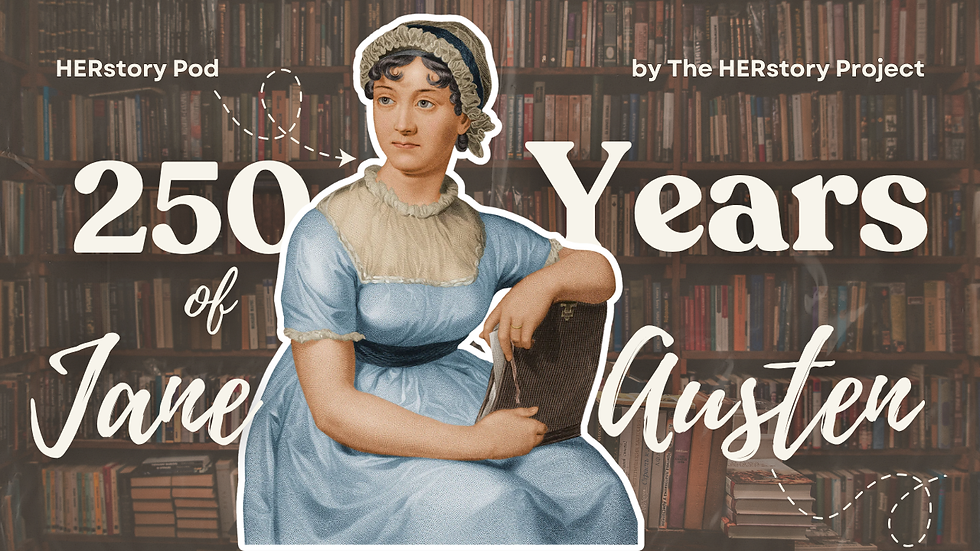
#15 250 years of Jane Austen
Jane Austen
Questions/musings for podcast:
So much to say about Jane Austen – what else is there to add?
New ideas and publications are coming out all the time, including works on fashion in Austen’s world, cosmetics, and her family
250th anniversary reminds us of her importance in the literary cannon and how we can never be certain that we know everything about her
One of the things that keeps us coming back to Austen is our need to know more about her. We feel like we can get closer to her through her books, because they are mostly what’s left of her – it is very likely that her sister destroyed most of Jane’s letters before her own death, so our knowledge of her is limited
Jane lived surrounded by revolution – political revolutions (French & American, Napoleonic Wars, abolition of slave trade), cultural (Gothic novels, the dawning of the nineteenth century Romantic era), societal (fashion, class, and race), and economic (boom in luxury spending, cost of war, the perceived need to spend less frivolously after the French Revolution)
Suffice to say, we’re not short of viewpoints to look at Austen’s works, but does this mean that she feels like an overwhelming subject? Are we tired of Jane Austen? Clearly not
Something for fun? Does her ghost haunt the house in Winchester where she died?
Key historiographical info:
Big debates on subject or person?
Previous ideas of Jane being a romantic writer (or SOLELY a romantic writer) are becoming less and less prominent. Romance plays a key part in her novels but ‘her novels … still really resonate with readers today … our concerns are still the same: finding friendships, meaningful friendships, and financial security … I think people who dismiss her are dismissing not only romance as a genre but also how clever she was in her observation of people’ – Lizzie Rogers, historian
How did Austen die? As seen below, there are lots of theories and debates about her death provide a way for Austen to remain in discussion (e.g. newer theory of arsenic poisoning
Edward Bridges: it’s still unclear as to weather Jane did or did not have a short-lived flirtation with someone called Edward Bridges in the summer of 1805. Moreso, there is speculation about whether or not she received a proposal from him – there is very little evidence either way on this topic
Why did Cassandra burn many of Jane’s letters? It’s not 100% confirmed that this did in fact take place, but there are lots of strong opinions about this event. Lizzie Rogers says this: ‘people criminalise Cassandra for having burnt them, but actually she was protecting her sister’s legacy’. Also, it was not an unheard of practice to destroy someone’s correspondence after their death, it was a way of preserving someone’s legacy
An author or historian who’s a key source? How has their work fed this episode
Because Jane Austen is so popular, there’s so much written about her. There are non-profit organisations that are dedicated to telling her story, including Jane Austen’s House ‘where Jane Austen lived and wrote her novels’. Jane Austen tourism is huge – e.g. Winchester is a key site due to it being where she died and is buried. Ghost walks around Winchester stop at the house she died in. Bath has the Jane Austen Centre
Interest in Austen has been renewed in 2025 due to the 250th anniversary of her birth. BBC History Magazine has created an entire special edition of their magazine dedicated to Jane, as well as the BBC also releasing a three part series on Jane’s life and works, and Netflix is creating a new adaptation of Pride and Prejudice.
There are key names in Austen scholarship, such as Claire Tomalin, whose work Jane Austen: A Life has been a key text about Jane since its publication in 1997. Lucy Worsley is also a key name in literary scholarship and has contributed to Austen debates through writing Jane Austen at Home (2017), as well as a BBC documentary about her: Jane Austen: Behind Closed Doors
Power implicated in the way this story has been traditionally told?
There has been a shift in the way we discuss Austen and her works – see how Lizzie Rogers discusses this shift in quote above. Other works contribute to this effort, such as Helena Kelly’s Jane Austen, The Secret Radical (2016)
We also see Austen through her works because of how many adaptations there are, e.g. two close film adaptations of Emma (1996 and 2020), the ITV series Sanditon, Sense and Sensibility (1995), and movies such as Clueless (1995) bring a fresh view and younger audience to her works, and you’ll still find Austen lovers debating whether the move or series adaptation of Pride and Prejudice (2005 and 1995 respectively) is better
Jane Austen biography:
The basics
Novels: Sense and Sensibility, Persuasion, Emma, Pride and Prejudice, Mansfield Park, Northanger Abbey, Lady Susan, Sanditon (unfinished), The Watsons (unfinished), plus various other writings including personal letters, plays, poems, and Juvenilia including Love and Friendship and The Beautifull Cassandra
Family:
Parents: Reverend George Austen & Cassandra Austen (née Leigh). Married in April 1764
Siblings (in chronological order): James (brother, born 1765), George (brother, born 1766), Edward (brother, born 1767), Henry (brother, born 1771), Cassandra (sister, born 1773), Francis (brother, born 1774), Charles (only younger sibling, brother, born 1779). Jane is the seventh of eight children and is particularly close to Cassandra, who is only two years older than her
Cousin: Eliza Hancock. First husband was Jean-François Capot, Comte de Feuillide. Eliza escaped the French Revolution in 1790, but her husband was arrested during the Reign of Terror and executed in 1794. Eliza went on to marry Jane’s brother Henry Thomas Austen, becoming Jane’s sister-in-law. Jane and Eliza first met in 1786 and maintained a close relationship. It is thought that Eliza inspired a variety of characters and storylines in Jane’s novels.
16th December 1775: born at Steventon Rectory in Hampshire.
1783-86: Jane and Cassandra attend schools in Oxford, Southampton, and Reading
1783: Jane nearly dies of Typhus fever
1787-94: Jane completes some of her early writings: Love and Friendship (1790), Lesley Castle (1792), Lady Susan (1794). Love and Friendship is dedicated to her cousin Eliza
1793: Jane begins writing a short play: Sir Charles Grandison or The Happy Man. She abandons the project.
1795: Jane writes an early version of Sense and Sensibility, Elinor and Marianne
Dec 1795 – Jane 1796: Jane’s flirtation with Tom Lefroy. Lefroy is studying to become a barrister and is taken away from Steventon after it is decided that the marriage would be impractical due to both having no money.
1796-97: Jane writes First Impressions, which later becomes Pride and Prejudice. The manuscript is rejected by Thomas Cadell, a publisher, after he is sent the manuscript by Austen’s father
1797: Henry Austen marries Eliza, making her Jane’s sister-in-law
1798-99: Jane writes Susan, which later becomes Northanger Abbey
1800: Jane completes her short play Sir Charles Grandison or The Happy Man
1801: Jane, Cassandra, and their parents leave Steventon and move to Bath after Jane’s father retires his position in the church
1802: Jane accepts a proposal from Harris Bigg-Wither, but declines the next day. Bigg-Wither is a childhood friend of the Austen family, and is heir to a large estate. Jane originally accepted for practical reasons, but declines after believing it would be a mistake to marry for these reasons
1803: Jane sells Susan to a publisher, Benjamin Crosby (Crosby & Company), through a family connection (her brother Henry’s lawyer). It is sold for £10 but not published
1804: Jane begins working on a novel, The Watsons, which would never be finished. The family spend the summer in Lyme Regis. Jane’s friend and mentor, Madam Lefroy, dies in December after a horse riding accident.
21st Jan 1805: Jane’s father dies and is buried in Bath. Jane, Cassandra, and their mother are now reliant on the brothers for support
Summer 1805: Jane possibly has a short-lived courtship with Edward Bridges
1806: Jane, Cassandra, their mother, and a friend Martha Lloyd move to Southampton to live with their brother Frank and his wife
1809: Jane, Cassandra, their mother, and Martha move to Chawton. Edward Austen offers Chawton House to the women rent-free. Jane confronts Crosby via letter in an attempt to force the publication of Susan; Crosby’s rebuttal is that he never set a timeline for the book’s publication. Jane’s only choices are to continue waiting for Crosby or to buy back the copyright for the novel, which at this point in time she cannot afford to do
1811: Sense and Sensibility is published ‘by a Lady’
1812: Jane sells the copyright of First Impressions to Thomas Egerton for £110
1813: Pride and Prejudice (previously First Impressions) is published ‘by the author of Sense and Sensibility’. Henry Austen acts at literary agent. Eliza, Jane’s sister-in-law, dies in April – Jane is at her bedside. Second editions of Pride and Prejudice and Sense and Sensibility are published
1814: Mansfield Park is published by Egerton – all copies sell out before the end of the year, making it Austen’s most profitable work of her career so far. Jane begins writing Emma. Jane’s niece writes to her seeking relationship advice, to which Jane responds that she should not marry without affection
1815-16: Jane writes The Elliots, which later becomes Persuasion.
1815: Jane is invited to the Prince Regent’s (later George IV) London residence at Carlton House by his librarian. The Prince Regent is an admirer of Austen’s work and implies that she should dedicate her next work to him. Despite her private but strong objections to the Prince’s moral character, she is left with little choice
1816: Emma is published and dedicated to the Prince Regent. Henry Austen buys back the still unpublished manuscript of Susan. A second edition of Mansfield Park is published. Jane becomes ill.
January 1817: Jane begins to write The Brothers, which later becomes Sanditon, only completing the first 12 chapters due to ill health
April 1817: Jane’s health worsens. She writes a short will leaving everything to Cassandra (‘dearest Sister Cassandra’)
May 1817: Jane leaves Chawton for Winchester accompanied by Cassandra in order to receive medical treatment
18th July 1817: Jane dies in Winchester aged 41. Her cause of death has been a source of conjecture since her death, with causes varying, including: Addison’s disease, cancer (various types including Hodgkin’s Lymphoma), Lupus, Tuberculosis, and Arsenic Poisoning. Arsenic poisoning is a more recent theory, supported by descriptions of skin discolouration in her letters
24th July 1817: Jane is buried in Winchester Cathedral. The inscription on her tomb doesn’t include any mention of her literary works
December 1817: Northanger Abbey and Persuasion are published by John Murray. Jane is identified as the author of the works – this is the first time her name is put to her work publicly
1820: Murray destroys any unsold copies of Northanger Abbey and Persuasion
1832: Richard Bentley purchases remaining copyrights to Austen’s works. He publishes all the works in a five-volume collection
1843: Cassandra destroys two-thirds of Jane’s letters
1845: Cassandra dies aged 72
1869: Jane’s nephew, James Edward Austen-Leigh, publishes A Memoir of Jane Austen, the first biography of Jane
1925: Sanditon is published
1949: Jane Austen’s House opens to the public
Context of time and place
Summary: The eighteenth century was a busy century and this continued into the nineteenth century. Some of the most important historical events from this period include French and American Revolutions, Napoleonic Wars, George III’s recurring ‘madness’, British colonial expansion, and trends that changed the cultural landscape. This century also saw the introduction of political structures that we still recognise today, including the first prime ministers . Also the capitalist structures that we recognise today become more ingrained in economic life; the eighteenth century economy is booming due to the slave trade and Britain’s colonial ambitions which resulted in the expansion of the British Empire and its trade routes. This means that luxury spending became a thing for the first time and people are buying items not just out of necessity any more. Spending money becomes crucial as a means of displaying wealth and staying in elite circles.
Political:
Monarchs: beginning of eighteenth century saw the end of the Stuart monarchy, with the House of Hanover invited to become English monarchs as a way of keeping the English monarchy Protestant. During Jane’s lifetime, George III reigned as king, with intermittent periods of illness dotted throughout
George III’s illness: 1788 Regency Crisis is brought about by George III falling ill and into various states of consciousness and cognisance. This period of instability ends in December 1789, but would reoccur, most notably in the period before his death 1810-1820. This period would result in the regency of his son George (future George IV), and has consequently been dubbed the REGENCY PERIOD, which is the setting most commonly associated with Austen’s works
French Revolution is one of the biggest political and social happenings of the century, causing seismic change in France and the fallout is felt all over Europe. Jane’s family was affected as her cousin Eliza (see above) was married to a French noblemen who did not survive the Reign of Terror. The subsequent Napoleonic Wars would continue to keep the memory of revolution alive to many – interestingly, one of the effects of the revolution was a shift in fashion trends from ostentation to frugality, which also involved the mass production of simple cotton dresses, such as those seen in many Austen adaptations
1772 judgement of Somerset v Stewart is passed – the judgement found that English common law did not support slavery and that to forcibly remove an enslaved person from England constituted illegal activity. This is widely accepted as the point in history when slavery became illegal in England, but the abolition of slavery would not be codified into law across the British Empire until the 1883 Slavery Abolition Act. The Somerset v Stewart judgement was issued by Lord Mansfield, the great uncle of Dido Belle, daughter of Mansfield’s nephew and an enslaved African woman known as Maria Bell (Dido Belle is the subject of the film Belle, and a 1776 portrait depicts Dido with her cousin Elizabeth Murray). Austen refers to the slave trade in few and indirect ways in her novels, but they do demonstrate an awareness of these issues, including in Mansfield Park, where the Bertram family’s wealth is the direct result of links to the slave trade in the West Indies
1773 – Boston Tea Party
1774 – Louis XVI becomes King of France, his wife Marie Antoinette becomes Queen
1775 – American War of Independence begins
1780 – Gordon Riots which were the result of anti-Catholic sentiment and the passing of the Catholic Relief Act
1783 – Treaty of Paris ends the American War of Independence
1784 – Pitt’s India Act gives more power to British Crown and the East India Company
1787 – Committee for the Abolition of the Slave Trade formed
1788 – trial of Warren Hastings begins, highlighting corruption and British oversees power in India
1789 – French Revolution begins with the storming of the Bastille in July
1793-94 – Reign of Terror in France, many members of the French aristocracy are guillotined, including Louis XVI (executed January 1793) and Marie Antoinette (executed October 1793). The acts of this time are largely orchestrated by Maximilien de Robespierre, who was himself arrested and executed in July 1794, bringing the Reign of Terror largely to an end
1799 – considered to be the end of the French Revolution when Napoleon seizes power
1801 – Act of Union creates the United Kingdom
1804 – Napoleon is crowned Emperor of France
1807 – Britain abolishes the slave trade
1810 – George III becomes ill
February 1811 – the Regency is established and George’s eldest son, the future George IV, becomes Prince Regent, effectively acting as king whilst his father is incapacitated
1812 – Napoleon invades Russia. United States declares war on Britain. Napoleon retreats from Russia
1814 – Napoleon exiled to Elba
1815 – Napoleon returns. Napoleon defeated at Waterloo
Cultural context:
Rise of Gothic novels. Notable works include Horace Walpole’s The Castle of Otranto published in 1765, Ann Radcliffe’s Mysteries of Udolpho (1794), and Matthew Lewis’s The Monk (1796)
David Garrick pioneers cultural efforts to increase appreciation for the works of Shakespeare. It is largely due to his efforts that Shakespeare is as revered as he is today
Frances Burney becomes a household name for her early publications (Evelina (1778), and Cecilia (1782) are big literary sellers). Burney becomes a big influence on Austen and it is conjectured that Austen derived her title Pride and Prejudice from one of Burney’s works
Charlotte Smith begins publishing her novels in the later half of the century
1789 – Olaudah Equiano publishes his autobiography. Equiano is a former slave
Boom in satire in the early part of the eighteenth century and becomes a way for social injustices and imbalances to be brought to public attention and critiqued, also reflects a big rise in print industry
Published works surrounding issues of morality, particularly around the French Revolution – e.g. Burke’s Reflections on the Revolution in France (1790) and Thomas Paine’s Rights of Man (1791)
1806-07 – Byron enters the scene
Sources:
These are just a handful of key and recent works on Austen, there’s so much more out there!
Jane Austen’s House: https://janeaustens.house/
Jane Austen website: https://www.janeausten.org/
BBC documentary: Jane Austen: Rise of a Genius (2025)
BBC documentary: Jane Austen: Behind Closed Doors (2017)
Lucy Worsley, Jane Austen at Home (2017)
Claire Tomalin, Jane Austen: A Life (1997)
James Edward Austen-Leigh, A Memoir of Jane Austen (1869)
Helena Kelly, Jane Austen, The Secret Radical (2016)
Helen Amy, Jane Austen’s England (2017)
Rebecca Smith, Jane Austen’s Guide to Modern Life’s Dilemmas (2012) and The Jane Austen Writers’ Club (2016)
Paula Byrne, The Real Jane Austen: A Life in Small Things (2013), and Jane Austen: Rise of a Genius (2025)
Roy and Leslie Adkins, Eavesdropping on Jane Austen’s England (2013)
Devoney Looser, The Making of Jane Austen (2019)
History Extra Collection’s Special Edition Magazine on Jane Austen is available now.
Power in Numbers
Programs
Locations
Volunteers