
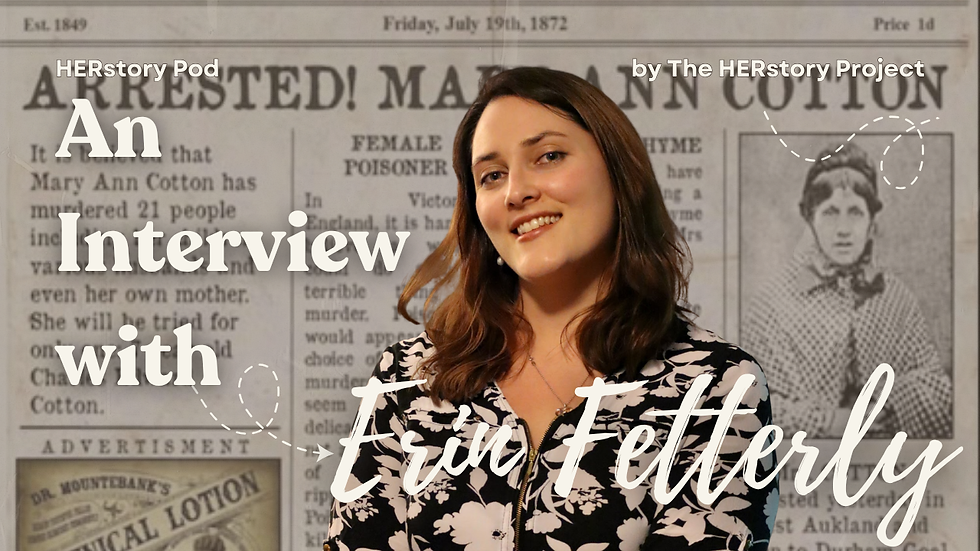
#16 An Interview with Erin Fetterly!
Interview
Today’s episode is the first (VERY FIRST) of our new interview mini series with authors, academics, phd students, ma students etc etc, which is intended to help our incredible community of young and early career historians to get their work out there in new, fun ways, and introduce our listeners to some of the fantastic work that’s out there. It’s also the first time we are interviewing a herstoryproj alum for the pod, which is very very exciting.
So in today’s episode we are joined by Erin Fetterly, a PhD student at Birkbeck, University of London. Erin’s research spans British history from 1650-1900, with a focus on women’s history, crime, medicine, science, manuscript writing and knowledge — and in October 2024, she published her first book, Women Who Kill: A History of Britain’s Most Dangerous Women.
We are going to try and cover as much of Erin’s work and experiences as a PhD student and author in this episode so if you’ve ever wondered what PhD life might look like, or what the best way to kill your annoying husband might be, this is the episode for you.
Erin, welcome to the show!
Silly little chat lol
Intro qs -
A/J - Let’s start right at the beginning - what first drew you to history in general, and particularly to women’s history and crime?
Other qs
What first drew you to this topic?Was there a moment when you realised, “This is what I want to research”?Did you always want to be a historian?You’re also working on a PhD aboutGeorgian women's knowledge and manuscript writing. How did you balance that project with writing a book?Can you tell us a bit more about your PhD research and what brought you to this topic?
Your bookWomen Who Killtraces female killers across seven centuries of British history. That’s a huge timeframe. Why did you decide to cover such a long period and not focus specifically on the 17th-19th c?When you talk about “dangerous,” are we talking about how society viewed these women, or how they viewed themselves?Women Who Kill: A History of Britain’s Most Dangerous Women.Was female violence treated differently than male violence in historical criminal systems?Can you give us an example of one story from your book that shattered your expectations?
Historiography
Is the way historians talk about crime and women changing right now?Do you feel historians have traditionally under-represented the agency of women - even when those women were criminalised?So much of your book deals with how society responded to women’s violence.Do you think those historical debates tell us anything about how we talk about women and crime today?
Silly little qs
If you could have dinner with one woman featured in your book - who would it be and why?
Best piece of advice you’d give to someone considering a PhD in history?
Most surprising discovery in your research?
Favourite historical era?
Book on your bedside table right now?
Historic figure you’d love to see reimagined in film?
Erin, Thank you so much for joining us! (waffle probably)
If listeners want to learn more, where can they find you?
Thanks for listening, please like, review, share, whatever platform you’re listening on and we will be in your ears with more delightful herstories next week
Xoxo
Gossip girl
Show notes
Separate Spheres debate - “women were secluded to the home, i.e. private sphere” and men were in “the public sphere”
Amanda Vickory
Amanda
Mary Aubrey - 1600s, french midwife
Power in Numbers
Programs
Locations
Volunteers