
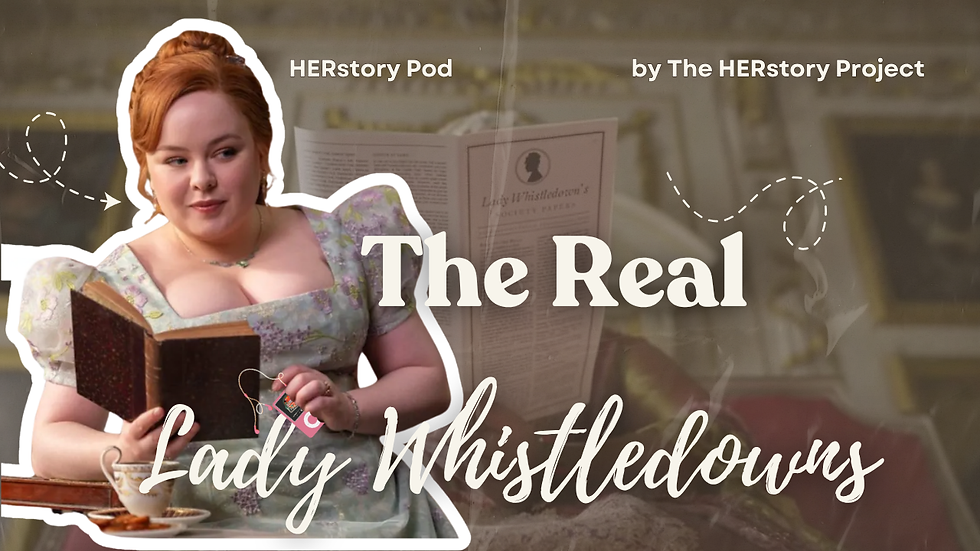
#18 Who were the real Lady Whistledowns?
Gossip Papers, Bridgerton
The Gossip Papers
Questions/musings for podcast:
Why are we all so fascinated by tales of the long eighteenth-century?
Similarities with our own time?
Commercial development (RG addition: the eighteenth-century saw the emergence of the capitalist economic system that we’re all familiar with today)
Culture of consumption (RG addition: luxury spending became a thing! The middle class emerged as a result of economic boom, and consequently the wealthier class were purchasing items for the sake of showing off their wealth!)
Importance of print culture in everyday life
What were gossip papers?
Gossip papers, often referred to as scandal sheets or gossip columns, were a means of distributing gossip and information - most commonly regarding the wealthy elite.
E.g 1770s Town & Country which ran a monthly column on the sex lives of England’s elite
Or The Morning Post, a highly popular paper that published light-hearted stories about high society which included exhaustive coverage of the balls of London’s social season
E.g the paper’s coverage of the Prince Regent’s 1811 fête in the drawing room at St. James’s Palace described exactly who everyone danced with:
“The first couple who tripped on the light fantastic toe were Earl Percy, and the accomplished, and deservedly celebrated beauty, Lady Jane Montague, daughter of the Duchess of Manchester”
When, if ever, was London taken over by Lady Whistledowns?
The heyday of gossip columns/scandal sheets was not in fact regency, but around the 1770s/80s - by 1770 there were sixty newspapers printed in London every week and a sophisticated network of news gathering and distribution
A little earlier than Bridgerton would have one believe …
Key historiographical info:
The circulation of printed media
Tim Clayton: heavily credits coffee houses and inns for circulation of ideas. Such establishments would purchase pamphlets, papers and prints to attract customers. The display of topical prints in shop windows also helped to circulate satirical images to the non-reading public. Moreover, advertisements in newspapers helped to alert audiences to an ever expanding market of prints and magazines.
The dawn of public opinion?
Press freedom as a mediation between parliament and people
This concept of public opinion was promoted by newspapers and reform groups from the 1760s
Radical MP John Wilkes’ only furthered this with his challenges to Parliament
Moreover, freedom was on the mind as a result of increasing radicalism in both America and France
Victoria Gardner: “contemporaries described a daily buzz around news acquisition in the metropolis as Londoners pounded the streets from one coffee house to the next, searching for up-to-date news”
What was a celebrity?
Stella Tillyard: “In the eighteenth-century someone possessing celebrity was at a simple level someone celebrated, the centre of a throng, a person surrounded, the object of joyous attention”
However, between 1763 and the mid-1780s, when the Peace of Paris ended the Seven Years’ War, Britain and Continental Europe were opened up to one another again, something approaching “a cult of celebrity did sweep Europe”
Attitudes to celebs: “It was feverish, sensational and evanescent, driven underground at the century’s end by religious revival, war, the collapse of optimism in many fields of endeavour, and the harsh moral climate that was the result”
Newspaper Context
General background
Following the restoration of the monarchy, the 1662 Printing Act heavily restricted news publications
It was only when this lapsed in 1695 that newspapers grew in relevance and significance
Previously, the number of printing presses was legally limited
Post-1695 anyone became free to set up a printing business and newspapers, pamphlets and prints were all produced in far greater numbers than ever before.
Helped to develop a more public culture
Increasing interest in the affairs of others
Known as a bit of an ‘English Casanova’
They married in August 1744, but kept it secret so that Elizabeth could maintain her position as a maid of honour
Marriage did not last as from 1749 the couple remained separated
Union only lasted four years as Kingston dies in September 1773
Kinservik: “By making the trial so public, he raised the stakes for everyone involved, thereby ensuring it would not be a speedy matter; rather, it would take at least a week, considerably enriching him with each passing day.”
Yates said the following in defence of his column
“[T]he anecdotes and rumours of these columns are gathered from the conversation of those who are most likely to be well acquainted with the topics under discussion. It must be further evident that occasionally stories which eventually turn out not to be founded on fact will creep in, but they are simply narrated as rumours, as what people are talking about, as “on dits” and are never vouchsafed as facts. (“Lounger” 71)”
Suggestion therefore that gossip was part of cultural life
Only furthered by the fact that writers such a Yates usually came from “theatrical backgrounds”
However, his eavesdropping did end up getting him into trouble as Yates ended up serving a four month sentence in prison for libel due to a false anonymous source - always check your sources ;)
18th-century printing boom
Annual newspaper circulation of 2.4 million copies in 1713, and 16 million in 1801
Joel Wiener: “By the 1870s, additional changes began to transform the ‘look’ and content of journalism: a greatly increased number of pictures and illustrations; livelier, personalised writing that emphasised human interest; and more attention paid to sports, gossip and other tangential variations of sensationalism”
Culture of bribery
Papers also gained a lot of ‘funding’ from the use of blackmail/bribery
E.g Robert Walpole, first PM, purchased The London Journal and spent over £40,000 bribing other papers to write favourably of him and his policies in the 1730s
Advertisement helped to reduce the need for such methods
But it was still persistent, especially when it came to the circulation of scandal
Commercial power
Increasing profits from advertisement freed papers from a dependence on political subsidies
Could now more freely report on whatever was thought to interest the purchasing public
What about libel?
Stella Tillyard, who wrote “Celebrity in 18th-Century London” for History Today: “The law of personal libel was so weak as to be non-existent”
By the 1750s public figures were commonly referred to in the press by the initials of their names or titles
With the King going by “a certain great personage”, or a “very great personage”
With these code letters/words no gossip was unprintable…
Tillyard: “A free press and a weak libel law created a climate of speculation and gossip far freer, more direct, personal and scurrilous than we have today”
Case study: Duchess of Kingston - trialled in April 1776
Background
Elizabeth Chudleigh or the Duchess of Kingston was on trial for bigamy
Last great state trial was Lord Byron’s manslaughter case a decade earlier, and it is safe to say that the tales of the Duchess spread like wild fire
Offers insight into both frivolous and criminal reporting at the time
Known as the ‘doubly-noble prisoner’, Chudleigh was a media sensation
At 22 (1743) she was appointed as a maid of honour to Augusta, Princess of Wales
Thus, she was quickly established as part of the ‘ton’
She soon met Augustus John Hervey, third son of John Hervey, 2nd Baron Hervey
Known as a bit of an ‘English Casanova’
They married in August 1744, but kept it secret so that Elizabeth could maintain her position as a maid of honour
Marriage did not last as from 1749 the couple remained separated
Union only lasted four years as Kingston dies in September 1773
Kinservik: “By making the trial so public, he raised the stakes for everyone involved, thereby ensuring it would not be a speedy matter; rather, it would take at least a week, considerably enriching him with each passing day.”
Yates said the following in defence of his column
“[T]he anecdotes and rumours of these columns are gathered from the conversation of those who are most likely to be well acquainted with the topics under discussion. It must be further evident that occasionally stories which eventually turn out not to be founded on fact will creep in, but they are simply narrated as rumours, as what people are talking about, as “on dits” and are never vouchsafed as facts. (“Lounger” 71)”
Suggestion therefore that gossip was part of cultural life
Only furthered by the fact that writers such a Yates usually came from “theatrical backgrounds”
However, his eavesdropping did end up getting him into trouble as Yates ended up serving a four month sentence in prison for libel due to a false anonymous source - always check your sources ;)
In 1750 she started seeing Evelyn Pierrepont, 2nd duke of Kingston
They co-habited, unmarried for close to 20 years - suggesting they may have had true feelings for each other?
In 1768 Hervey reentered her life and requested a formal separation
They colluded in legal subterfuge to get the ecclesiastical courts to annul their marriage - it never existed
The following month Elizabteth married Kingston
Union only lasted four years as Kingston dies in September 1773
Kinservik: “By making the trial so public, he raised the stakes for everyone involved, thereby ensuring it would not be a speedy matter; rather, it would take at least a week, considerably enriching him with each passing day.”
Yates said the following in defence of his column
“[T]he anecdotes and rumours of these columns are gathered from the conversation of those who are most likely to be well acquainted with the topics under discussion. It must be further evident that occasionally stories which eventually turn out not to be founded on fact will creep in, but they are simply narrated as rumours, as what people are talking about, as “on dits” and are never vouchsafed as facts. (“Lounger” 71)”
Suggestion therefore that gossip was part of cultural life
Only furthered by the fact that writers such a Yates usually came from “theatrical backgrounds”
However, his eavesdropping did end up getting him into trouble as Yates ended up serving a four month sentence in prison for libel due to a false anonymous source - always check your sources ;)
Why ‘doubly noble’?
1775 - Hervey became 3rd Earl of Bristol
Ie noble regardless of which man you consider to be her husband
Doubly a media sensation?
The issue of inheritance
Kingston left his entire estate to Elizabeth on the condition that at her death or remarriage, the estate was to go to Kingston’s nephew Charles Medows
His older brother Evelyn Medows was disinherited and therefore attempted to undermine the will by contesting the validity of Elizabeth’s marriage
Ultimately leading to her trial
Trial outcome
22 April 1776 119 lords pronounced Elizabeth guilty
Elizabeth claimed privilege of peerage and escaped punishment leaving England the following day
Spent the next decade in Paris
Gossip and the trial
Trial itself functioned as a high society event
Due to her title Elizabeth was trialled in the House of Lords
Seating was limited and highly sought after so newspaper notices warned women not to wear their hair too high as it would obstruct the view of the trial
Coffeehouses opposite the Lords were reserved for the festivities by esteemed guests - often the centres of satirical art and gossip circulation
Why was a public trial so advantageous?
Many people profited, notably newspapers and gossip columns alike
Historians such as Matthew Kinservik noted that for Henry Bathurst, the Lord High Steward and therefore the presiding judge, the media frenzy was extremely financially beneficial
As Lord High Steward he was due to be paid £1000 per day
Kinservik: “By making the trial so public, he raised the stakes for everyone involved, thereby ensuring it would not be a speedy matter; rather, it would take at least a week, considerably enriching him with each passing day.”
Yates said the following in defence of his column
“[T]he anecdotes and rumours of these columns are gathered from the conversation of those who are most likely to be well acquainted with the topics under discussion. It must be further evident that occasionally stories which eventually turn out not to be founded on fact will creep in, but they are simply narrated as rumours, as what people are talking about, as “on dits” and are never vouchsafed as facts. (“Lounger” 71)”
Suggestion therefore that gossip was part of cultural life
Only furthered by the fact that writers such a Yates usually came from “theatrical backgrounds”
However, his eavesdropping did end up getting him into trouble as Yates ended up serving a four month sentence in prison for libel due to a false anonymous source - always check your sources ;)
Not only huge for London papers and mags - large provincial interest
Reportings in Ireland, Scotland and Welsh papers.
Much focus on her as crazed woman
Hampshire Chronicle, 29 April 1776: “The Duchess was so exceedingly affected whilst she delivered several parts of this speech, that she was seized with hysterics, and in that condition was carried out of the court”
In her death, memoirs were printed in papers up and down the country with extensive focus on her status and the intricacies of her trial
Case study: Richard Worsley and Seymour Worsley of Appuldurcombe House
Quick character summaries
James Gilray
Took up caricature in 1780
Known for satirical illustrations or prints
Sir Richard Worsley and Lady Seymour Worsley
Husband and wife
Richard inherited Appuldurcombe (Isle of White) in 1768
The two met in 1772, and by 1776 were married with a son
Seymour soon sought solace in fashionable society
Hanging out with the Duchess of Devonshire
George Bisset
Arrives on the island in 1780
Shortly after his arrival he is made captain of Worsley’s militia
Geo/political context
Threat of French invasion looming - local troops ordered to assemble in Kent
As a result, Worsley’s militia, including Bisset and Lady Worsley, moved to the mainland
All moved together to a large house in Maidstone
The affair
Soon George and Seymour were seeing each other
And then eloped
This led to Richard’s decision to “sue George for a cripplingly massive sum of money, on the grounds that his treacherous captain had ‘damaged’ his wife”
Rumours swirled as this was believed to be Lady Worsley’s 28th affair/sexual conquest
The trial
Sensing a theme?
Trials were events of the season, especially if they were scandalous and involved the elite
One of the most damning pieces of evidence in George’s favour was the tale of the bathhouse…
In September 1781 George, Seymour and Sir Richard decided to visit a local segregated bathhouse
Supposedly the men found a high window above the women’s bathing rooms and Richard offered George a view of his wife
As one can imagine such details resulted in a press frenzy with famous satirist James Gillray creating multiple prints inspired by the events
‘Sir Richard Worse-than-Sly, Exposing his Wife’s Bottom - O fye!’, 1782, James Gillray
‘A Peep into Lady W!!!!!y’s Seraglio, 1782, James Gillray
Hardly an attempt to hide the identity of the subject…
The trial outcome
After such a media circus, it was clear that there was very little sympathy for Richard within public culture
Richard was therefore awarded compensation of a single shilling
Details of the trial were covered minute by minute
Resulted in the publication of pamphlets such as ‘Amorous Adventures of Sir Richard Easy, and Lady Wagtail’
The development of the gossip papers:
Turning point
In the 1840s mainstream newspapers moved towards cleaner subjects
leading to the shuttering of scandal sheets like the Age, the Satirist, and the Town.
Remaining ‘scandal rags’ were prohibited by the Obscene Publications Act of 1857”
However, the publication of oral gossip was still popular
“Longer at the Clubs”
Gossip column established in 1855 by Edmund Yates
He was the ultimate eavesdropper - He paid people for gossip that was overheard at elite events to put in his publication
Yates said the following in defence of his column
“[T]he anecdotes and rumours of these columns are gathered from the conversation of those who are most likely to be well acquainted with the topics under discussion. It must be further evident that occasionally stories which eventually turn out not to be founded on fact will creep in, but they are simply narrated as rumours, as what people are talking about, as “on dits” and are never vouchsafed as facts. (“Lounger” 71)”
Suggestion therefore that gossip was part of cultural life
Only furthered by the fact that writers such a Yates usually came from “theatrical backgrounds”
However, his eavesdropping did end up getting him into trouble as Yates ended up serving a four month sentence in prison for libel due to a false anonymous source - always check your sources ;)
Starkly different however to the earlier Georgian gossip column
As explored by Lauren Mccoy: “Victorian gossip writers and editors often suggested that newspaper content was too dry and perhaps needed something like a gossip column to convey liveliness and a personal connection to the news”
But only in moderation
Placed in the interior pages near art and literary criticism
Suggestion therefore that gossip was part of cultural life
Only furthered by the fact that writers such a Yates usually came from “theatrical backgrounds”
However, his eavesdropping did end up getting him into trouble as Yates ended up serving a four month sentence in prison for libel due to a false anonymous source - always check your sources ;)
Whereas, Mccoy: “Georgian-era scandal sheets used coarse language and covered even coarser issues, as the title of the adultery-focused Crim-Con Gazette makes clear”
Thrived off blackmail and intimidation tactics
Yates and his “Lounger” fit in well as part of this newfound sanitised culture
Yates went on to publish The World - first society journal
Signified the commercial success of gossip column
These journals mainly focused on gossip, rather than news
However, his eavesdropping did end up getting him into trouble as Yates ended up serving a four month sentence in prison for libel due to a false anonymous source - always check your sources ;)
Sources
Clayton, Tim. “Satire and Scandal: Media in 18th-Century England”, English Heritage, https://www.english-heritage.org.uk/visit/inspire-me/18th-century-satire-and-scandal/
Gardner, Victoria. “Eighteenth-century newspapers and public opinion”, The Routledge Companion to British Media History ed. Martin Conboy and John Steel, 2014.
Kinchin-Smith, Sam. “Lady Worsley’s Scandalous Story”, English Heritage, 2019, https://www.english-heritage.org.uk/visit/inspire-me/blog/blog-posts/lady-worsley/
Kinservik, Matthew. Sex, Scandal, and Celebrity in Late Eighteenth-Century England, Palgrave Macmillian, 2007.
Mccoy, Lauren. “Waifs and Strays of Town Talk”, Victorian Review, John Hopkins University Press, Vol. 43, No. 2, 2017.
Taylor, Elise. “Bridgerton: The Real-Life Lady Whistledowns of Regency-Era England”, Vogue, 2020, https://www.vogue.com/article/bridgerton-the-real-life-lady-whistledowns-of-regency-era-england
“‘The doubly-noble prisoner’: The trial of Elizabeth Chudleigh, countess of Bristol, or duchess of Kingston?”, History of Parliament, 2021, https://historyofparliament.com/2021/10/07/trial-of-elizabeth-chudleigh/
Tillyard, Stella. “Celebrity in 18th-Century London”, History Today, Vol. 55, No. 6, 2005, https://www.historytoday.com/archive/celebrity-18th-century-london
Ross, Marlon. “Scandalous Reading: The Political Uses of Scandal in and around Regency Britain”, The Wordsworth Circle, Vol. 27, No. 2, 1996.
Ryan, Yann. “Newsbook to Newspaper: Changing Format, Layout and Illustration in Seventeenth- and Eighteenth-century Periodical News”, The Edinburgh History of the British and Irish Press ed. Nicholas Brownlees, Edinburgh University Press, 2023.
Wiener, Joel. “The nineteenth century and the emergence of a mass circulation press”, The Routledge Companion to British Media History ed. Martin Conboy and John Steel, 2014.
//
Additional primary sources from Gale Online - Burney Newspapers Collection
Power in Numbers
Programs
Locations
Volunteers