
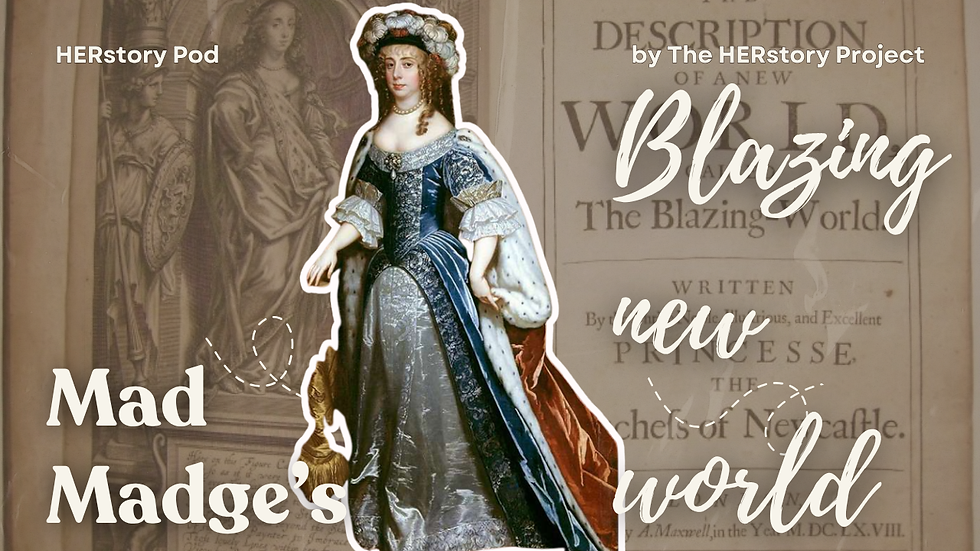
#6 Mad Madge
Stuart History, Duchess of Cavendish
Childhood
BORN: it’s thought she was born around 1623 in St. John's Abbey, near Colchester, Essex born at St John's Abbey, near Colchester, Essex
Father: Thomas Lucas (c.1573–1625)
Mother: Elizabeth Lucas (d.1647)
Though wealthy, her father bore no title and Margaret makes it a point in her own autobiography to stress that he never bought a title though he had the wealth to
Her parents relationship had been rocky at the start as Thomas has been banished for dueling and was unable to marry Elizabeth, leading to her older brother Sir Thomas Lucas being born out of wedlock but they recovered due to the families political connections once James I came to power
Siblings: Margaret was the youngest of eight siblings, the eldest being brother Thomas
Early life
Most of what we know here again comes from Margaret’s own autobiography ther
She paints the picture of a happy family torn apart by civil war even thoguh her father died only a few years after her own birht. Her mother seemed to have managed her jointure and estates well and protected her sons inheritance from the courts - it was clear Margaret grew up around a strong female example and influence
The family split time between Colchester and England and Margaret received a fairly rudimentary education from tutors
Her brother was a staunch royalist (as was the whole family) and his known dislike for the lower classes won him little local support leading to the family home to be sacked in a raid in 1642
Shortly after this Margaret left Colchester for Oxford where her sister lived as well where the royal court was staying partially for her safety but also likely to try and secure a position in the court of Queen Henrietta Maria which she did as a lady in waitinig in 1643.
When the royal court fled for Paris during the Civil War in 1644, she accompanied the Queen into exile
Marriage
It was in Paris in exile that she met her future husband, William Cavendish, the Marquess of Newcastle Upon Tyne whose first wife had died in 1643.
Despite Margaret’s descriptions of herself as bashful and shy Cavendish and Margaret seemed to have brought out the best in each other and been truly in love. Many were opposed to the match including the Queen and many of William’s friends.
William background: William was also a royalist and had led the royalist army to defeat at an early battle causing his own exile from England
Despite opposition the pair married in late 1645 by the English chapliamn in exile.
Children: though Margaret tried to conceive, even seeking fertility treatments in Paris, the couple never had any children, though William had five children from his first marriage who survived into adulthood
Couple in exile: Margaret’s marraige portion of 2,000 couldn’t be paid right away so the couple did not have a ton of funds. They moved to Rotterdam before settling in Antwerp in a house they rented from the widow of Rubens.
Early in their marriage in 1648, back in England, Margaret’sbrother Sir Charles Lucas was executed aftr teh siege of Colchester
Margaret then spent 18 months in England startin in 1651 trying to gain access to funds from her husabnds estates which had been sequestered by the new government. The requests were eventually denied and she returned to Antwerp and a time of financial hardships for the couple.
Permanent Return to England: when Charles II returned to England for his restoration, William went with him, and Newcastle followed shortly after. However she was disappointed he’d failed to obtain the political office she thought he deserved
Finally in 1660 Newcastle managed to have his estates restored by royal charter - shortly after the two retired from London which seemed to better suite Margaret’s temperament
It was after this point that Margaret wrote most prolifically - it was also around this time that she started to exert influence and control in the governance of the estate leading to increases in the families income and weal
William himself was quite a well-known playwright and the pair made for London again in 1667 where they once again made the rounds and even were invited to attend shows at the Scientific Royal Society from leading minds including Robert Hooke
Margaret made a huge splash on this trip for both her mind, speech, and perhaps most notably her dress. Samuel Pepys compared her to the cross-dressing Queen Kristina of Sweden (she was known to where strange fashion and indeed delighted in it) and was described as both attractive, flirtatious, and at times obscene in her speech
Later Life and Death: Margaret continued to write thorughout her life after her journey to London
She died on 15 Dec. 1673 at her home in Welbeck Abbey Nottinghamshire and was burried 7th Jan. 1674 in Westminster Abbey
Upon her death, in addition to an elaborate funeral procession thorugh London which she herself ordered, her husband published Letters and Poems in Honour of the Incomparable Princess, Margaret, Duchess of Newcastle (1676)
Literary wo
First publication: Margaret first published while in England with her brother in law while her husband was still in exile. This was her Poems and Fancies - this was a series of poems explicating her atomic theory following Epicurus which was reminiscent of the work of her contemporaries like Walter Charelton - atomic theories of science and philosophy were gaining popularity with increasing speed at this time
The work made an immediate impact with society figures commenting not only on Margaret’s personal eccentrism but that of her work
It was of this piece that Dorothy Osborne opined that there were 'many soberer People in Bedlam'
Writings in Exile: back home in Antwerp despite financial hardship Margaret continuedc to write
Here she pbulished The World's Olio which includes a range of her observations on a variety of topics including scorching remarks on historical and mythological figures
She explores her views on philosophy in Philosophical and Physical Opinions where she partially follows Hobbes materialist naturalist philosophy though she’d later part with his thinking
Finally, she publishes Nature's Pictures, a collection of love stories which pay particular attention to sex and gender and is also full of satire at times. The first edition of this also contains her autobiography, A True Relation though she did not republish this in later editions thinking it lessened her reputation
Writings back in England
Margaret was not afraid to use her writing to interfere in politics as is clear in one of her earliest works back in England, The Lotterie which was written for a private royal performance likely to secure royal favour for the couples bid to get Cavendish’s lands returned
Writings in the Country: It was here that Margaret wrote most prolifically
Plays (1662) also considers issues around sex and gender and in Bell in Canto contains depctions of women going to war with historians like Battigelli argueing that Margaret saw herself as a kind of military leader and saw Henrietta Maria in a similar model
CCXI sociable Letters (1664) is a series of fictional letters between two women including lots of commentary around marriage that seem to act as a sort of warning for women against the institution, a common theme in her work despite her largely happy and living relationship with Wiliam
Philosophical Letters (1664) critique a range of male philosophers including Descartes, Helmont, Hobbes, and More, the first time she engaged in direct dispute with other philosophers
Orations of divers sorts (1665) which is a series of speeches exploring certain questions
In one of these she explores the following series without any resolute answer: Are women in fact subordinate to men in society? If so, is the cause of this insubordination a natural inequality between the sexes or a lack of opportunity for women, particularly as regards education?
Observations upon Experimental Philosophy (1666) is perhaps Cavendish’s most famous work because it contains The Description of a Blazing New World a piece of radical utopian science fiction nearly unheard of at the time which many argue depict Margaret herself (largely as the character is origianlly referred to as the Duchess of Newcastle) who later becomes an empress upon landing in a new world where the men instantly revere her. The piece as a larger work also harshly refutes Hookes Microcosmographia one of the first pieces in England to popularise the modern idea of two sexes with seperate male and female anatomy thoguh she also rejected these older anatomical and natural philosophical views (largely based on Galen and Aristotle)
This is the first utopian novel by a woman and one of the few early utopian novels we have beyond More’s - in 1668 it was published as it’s own work titled a New World Called the Blazing-World
“No sooner was the Lady brought before the Emperor, but he conceived her to be some goddess, and offered to worship her; which she refused, telling him, (for by that time she had pretty well learned their language) that although she came out of another world, yet was she but a mortal; at which the Emperor rejoicing, made her his wife, and gave her an absolute power to rule and govern all that world as she pleased. But her subjects, who could hardly be persuaded to believe her mortal, tendered her all the veneration and worship due to a deity. (The Description of a New World, Called the Blazing-World)”
Margaret continued to publish works into her later life including Plays Never before Printed (1668)
Impact
A literary icon who shows that women could write and she could write with range
Though important to note only certain women - she came from independent wealth and thus could largely write without patrons and on whatever subject she chose where most authors in this age were still largely reliant on commission
Her philosophy did actually make significant contributions to the canon at the time, even if not always as cited as other pieces of work - she was up to date and contributing to and even contrasting current debate
Similarly her plays (as were her husbands) found levels of popularity as did her poetry
She showed that women of a certain class could live radically in the period after the revolution (circumstances are important here)
Her utopian work is incredible in how ahead of it’s time it was in providing such strong examples of female leadership not out of necessity but as the ideal
Power in Numbers
Programs
Locations
Volunteers